700 MW Lands in Cork, Cracks Dublin's Compute Ceiling
Energisation is June, full commission 2028, but every vendor pricing Irish AI-compute capacity past 2027 should already be re-running the model.
This is the first link between the Republic of Ireland, a member of the European Union, and mainland Europe. We aim to facilitate the flow of energy across Europe.
— Rémi Courtial, RTE project director for Celtic Interconnector (opens in a new tab)
- The 700 MW headline is not the story. The option to import French surplus into Ireland's grid queue is what re-prices vendor capacity math.
- Vendors who locked Irish capacity at 2024-2025 scarcity rates are about to see the premium stop compounding. Their cost basis just hit a soft ceiling.
- Cork goes from vendor-deck buzzword to a legitimate Dublin alternative for any workload that does not need sub-millisecond London latency.
- Push for re-pricing windows on any Irish-compute contract that crosses June 2026. Three-year flat-rate deals at current rates are bad math.
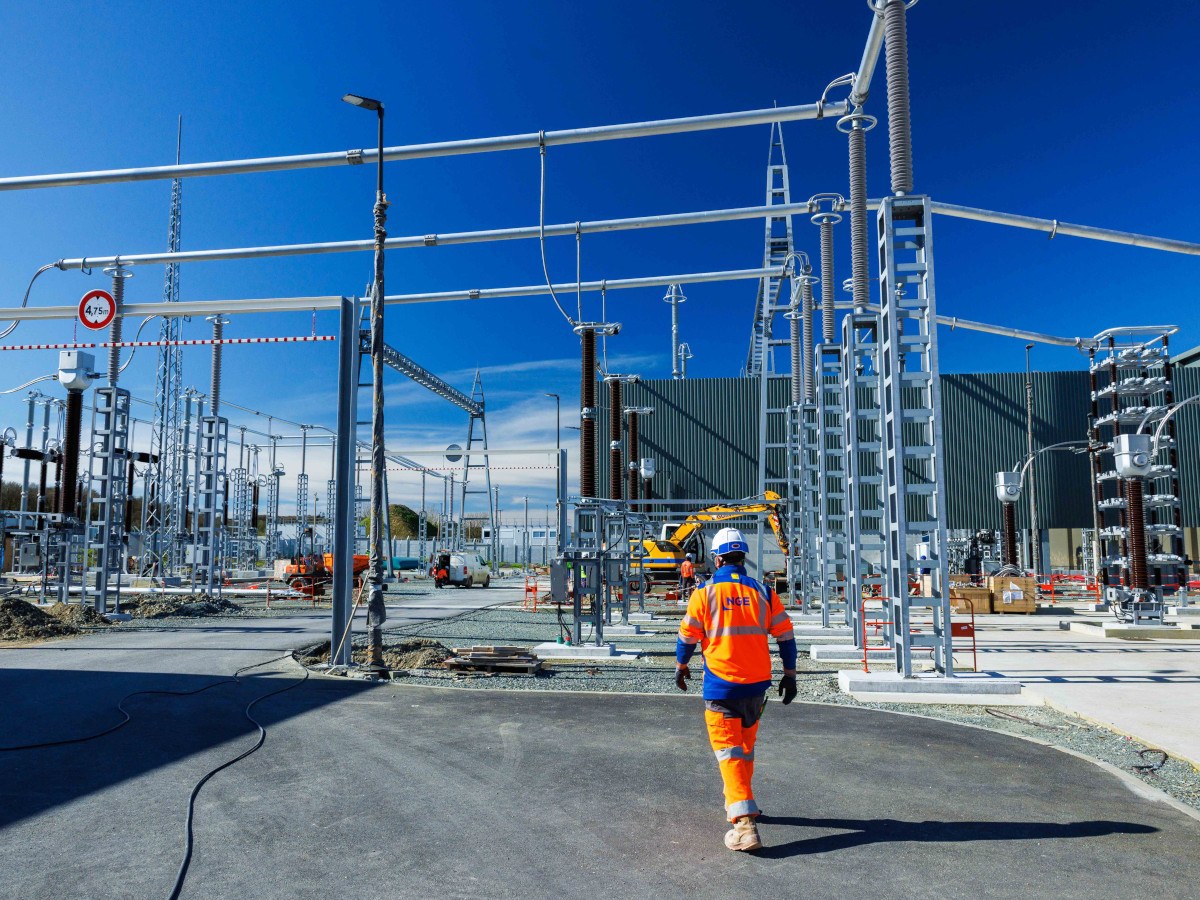
The Irish data-centre category has been constrained on two axes simultaneously: the local grid is at capacity, and the political ceiling on new connections has hardened. This week's milestone on the Celtic Interconnector quietly addresses one of them. NGE and Siemens Energy completed main construction on the Ar Merzher converter station in Brittany, which means the 575-kilometre subsea link between Cork and France is on track for energisation in June and full commission by 2028. For any operator pricing Irish compute capacity past 2027, the 2028 grid sheet just changed shape.
The Deployment
NGE, in partnership with Siemens Energy, completed main construction works on the Ar Merzher converter station in Brittany on Tuesday, on behalf of Ireland's EirGrid and France's RTE. The station is the French endpoint of the Celtic Interconnector, a 575-kilometre subsea high-voltage DC cable that lands in Cork and carries 700 megawatts of exchange capacity in either direction. RTE describes that capacity as roughly 450,000 households' worth of electricity. For an AI-infrastructure reader, the more useful framing is that 700 MW is comparable to the contracted demand of a single hyperscale campus, or to a meaningful slice of a constrained regional grid.
The remaining mechanical works are scheduled to wrap in May. Energisation begins in June 2026. Full commercial operation is expected by 2028. RTE's project director Rémi Courtial framed the link as the first physical connection between the Republic of Ireland and mainland Europe. NGE's chief executive Stéphane Perez positioned it as evidence of the firm's capacity to deliver complex cross-border infrastructure aligned with Europe's energy-sovereignty agenda.
The political shape of the project matters as much as the engineering. Ireland's grid has, until now, been an island that talked only to Northern Ireland and, via the existing link, to Britain. France's grid sits on the other end of the new cable with structurally surplus generation on most days.

Why It Matters
Ireland is the most contested AI-compute geography in the EU, and the bottleneck is not silicon. It is grid. EirGrid's connection queue for new data-centre load in the Dublin region has been a known constraint for years; new builds get approved when and if upstream generation and transmission capacity expands to support them. Every announcement from Dublin or Cork, every "we're opening a regional hub" or "we're standing up an Irish inference cluster", has been priced against a baseline where new megawatts arrive slowly and politically.
The Celtic Interconnector breaks that constraint asymmetrically. 700 MW is not a hyperscale-killing number on its own. The change is the direction of the option. With Britain post-Brexit and post-grid-stress, importing from Wales has been a one-way street with shrinking surplus. France imports nothing it cannot make at home and runs a structural surplus on most days. Cork as the Irish landing point also changes which campuses can plausibly bid for the new headroom, and Cork has been pitched in vendor decks for two years as the next Dublin without the connection queue.
The read for the operator-buyer is straightforward. Vendor pricing for Irish-located inference, training, and managed-AI capacity has been quietly rising on a "grid scarcity" premium for at least eighteen months. That premium had no exit. It now has one. Slow, mechanical, but real, with a two-year glide path to commercial operation. Anyone signing a 2027–2029 capacity deal in Ireland should be modelling the cable as a soft cap on that premium, not as upside.
This echoes the Northern Virginia substation expansion cycle a few years back. Same shape: a regional grid was the actual product the hyperscalers were buying, not the silicon. When the substations came online, regional pricing softened, and the buyers who had signed multi-year power-shadowed deals at peak scarcity wished they had not. The Celtic Interconnector is the Irish version of that transition, two cycles later.
What Other Businesses Can Learn
For mid-market operators evaluating Irish AI capacity, whether that is a Cork-based fintech buying an inference contract from a regional cloud, a Dublin SaaS firm sizing a 2028 training run, or a UK or German firm choosing where to locate a European AI workload, the practical implications are concrete.
First, your 2027 capacity quote is not your 2028 capacity quote. Vendors who locked in long-haul power contracts at 2024–2025 scarcity rates are about to see their cost basis stop rising. The negotiating use for any contract that crosses the energisation date in June 2026 has measurably shifted. Push for shorter primary terms with mandatory re-pricing windows tied to grid-cost benchmarks. Do not lock in three-year flat-rate compute deals priced to current scarcity assumptions.
Second, Cork is suddenly a legitimate alternative to Dublin for any workload that does not require sub-millisecond latency to a London or Frankfurt market venue. Vendor pitches will start arriving with Cork-located capacity priced below the Dublin equivalent within twelve months. For a 50-person ops team running batch inference, training, or RAG-heavy analytics, the Dublin premium has rarely been justified on technical grounds. It has been justified by inertia and by the fact that nobody else had spare capacity. Both of those are about to change.
Third, the political risk has shifted, not vanished. Cross-border interconnect projects can slip. Full commissioning in 2028 means the cable is fully live in 2028 at the earliest, and large infrastructure projects routinely push timelines by twelve to eighteen months. Build that contingency into anything that depends on the cable going live on schedule. The energisation event in June is the de-risking moment that matters; it is the point at which the cable physically carries current, even if commercial operation comes later.
The Celtic Interconnector is not the cheapest cable Europe has built, but it is the most consequential one for Irish AI-compute pricing in the next decade.

Fourth, watch the ESG framing. RTE and EirGrid are positioning the link as decarbonisation infrastructure: French low-carbon generation flowing into Irish data centres, displacing Irish gas peakers. Buyers under 2026–2028 reporting obligations get a clean-power-attestation upgrade out of this, separate from the pricing impact. That matters for procurement teams whose RFPs have started asking for grid-mix attribution alongside SLA terms. The cleanest sentence in the announcement is the one Courtial closes with: every European country benefits from each other's decarbonised energy. Read that as procurement-policy language, not climate rhetoric, because the buyers' RFPs will start treating it that way.
Fifth, the unit economics of "Ireland-located" are about to bifurcate. Workloads that use the new headroom will price differently from workloads that sit on the old, queue-allocated capacity. Get clear from your vendor which side of that line their proposed campus sits on. The cheap answer for the next eighteen months is the campus that is buying its incremental megawatt off the new cable, not the one that is buying it off the existing peaker fleet.
Looking Ahead
Watch the energisation event in June. The market reads first-energisation as the de-risking moment, even though commercial operation does not begin until 2028. Vendor pricing on Irish capacity should start moving on the energisation news, not on the commissioning news, because the option value is what re-prices, not the megawatt-hour delivered.
The named comparable to watch in the next twelve to eighteen months is the proposed Greenlink expansion between Ireland and Wales. If a second cable moves into construction on a credible timeline, the Irish grid stops being the binding constraint on European AI capacity altogether, and the Cork-Brittany cable becomes the first of three rather than the only one. the scenario in which Ireland goes from compute-constrained to compute-competitive on a structural basis. The Celtic Interconnector milestone today is what makes that scenario plausible enough for the procurement model to take seriously.
Related
- AI data centres hit 29.6 gigawatts at the NYC peak
- Anthropic axes the custom chip as $3B a year bleeds Nvidia
- Oracle ARM always-free tier in 2026: the real limits
Sources
More from the same beat.
303 Routes, 0 Red Gates: Static Export Still Needs a Preflight
A green build is not release clearance. The artefact needs its own route, metadata, link, and visual checks.
- Treat out/ as the release candidate.
GLM-5.2 Cleared the Six Hard Tasks I Use to Vet Any Cheap Model
A new open-weights model matched my flagship on objective hard tasks. The battery I run before trusting any cheap model in production did not change.
- A leaderboard rank is a reason to test a model, not a reason to trust it. I keep a fixed battery of objective hard tasks with execution-checked answers and run it on every cheap or open release bef…
GLM-5.2 Ships 753B Open Weights. My GTX 1660 Holds 6 GB.
The most powerful open-weight model of mid-June 2026 needs a cluster. A 4B model on a 6 GB card taught me what that headline leaves out.
- Open weights and a model you can run are two different claims. GLM-5.2 ships MIT weights at over 750 billion parameters, and none of that helps a 6 GB card.