Governance Over Volume: The Agent Category Grows Up
Banks have been chasing deployment counts for two years. The next renewal cycle pays for the audit trail, not the agent headcount.
Success in banking will not be defined by how many AI agents are deployed but by how well they are governed across the lifecycle.
- Agent-count metrics just aged out as a renewal narrative; banks now buy on governance posture, not deployment volume.
- RPA's 2020 governance reckoning is the cleanest precedent for what the agent-platform category is about to absorb.
- All-in-one platforms now compete with dedicated agent-observability vendors on the audit pass, not the agent builder.
- Operators: budget a governance line item this cycle. The renewal conversation in twelve months runs on the register, not the count.
The agent-platform category sells itself on counts. How many bots deployed, how many workflows automated, how many minutes saved per ticket. The numbers are the pitch deck and the renewal narrative both. Banking Dive's read on the next phase of agent adoption in financial services breaks that pattern in one sentence: success will not be defined by how many agents are deployed but by how well they are governed. the line in the sand the category has been moving toward for the better part of eighteen months, and once a banking trade publication leads with it the shift is no longer a forecast.
The Deployment
What the source frames is not one bank's rollout. It is a category-wide reset on the metric that defines a successful agent program. The deployment story banks have told themselves and their boards for two years runs on volume. Count the agents in production. Count the workflows touched. Count the FTE-equivalent hours displaced. Banking Dive's framing pivots that conversation to governance: controls, audit trails, model risk management, drift detection, escalation paths. the bar separating good agent programs from great ones in the source's read. The piece does not name a single bank, a single vendor, or a single dollar figure as the headline of the shift. The shift itself is the story.
Why It Matters
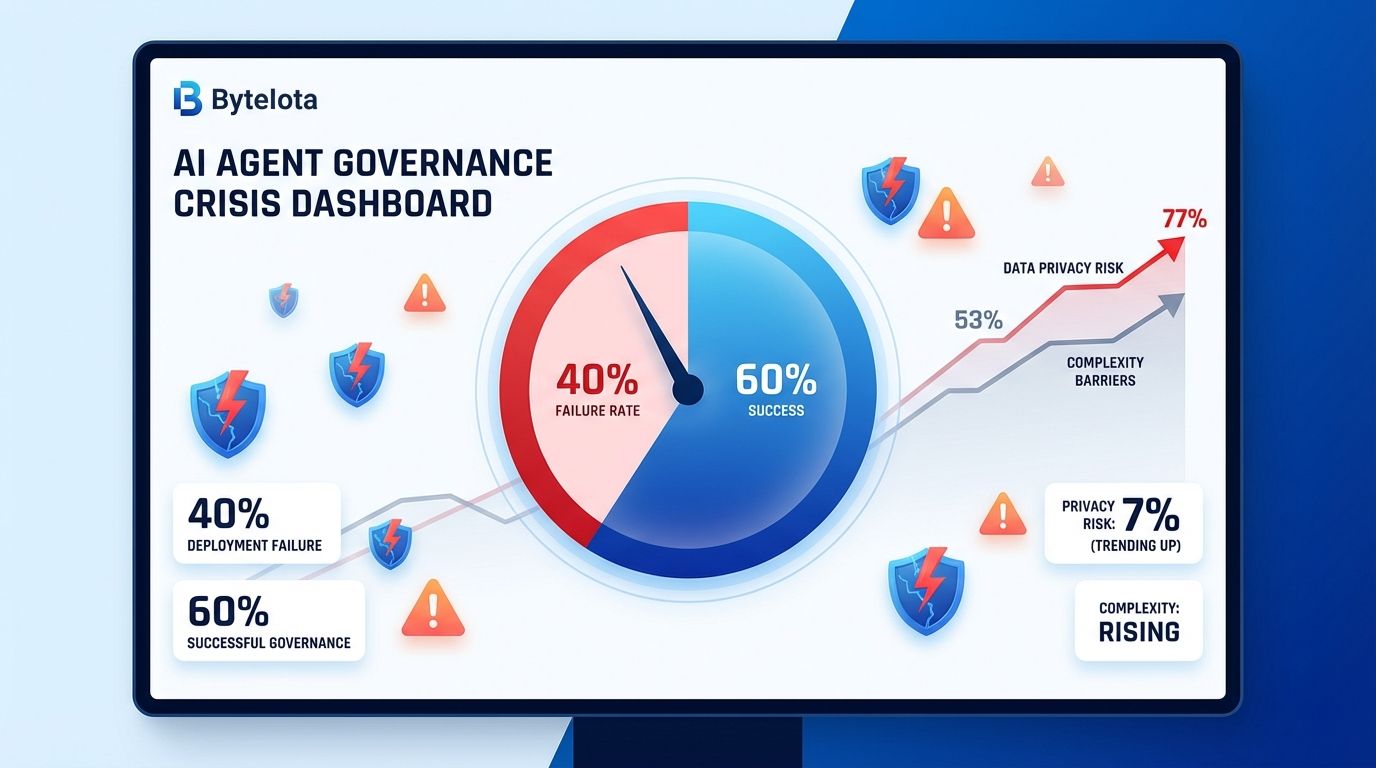
The agent-platform category is doing what every B2B software category does at the eighteen-to-twenty-four-month mark of a hype cycle. It is trading a deployment-count metric for a governance metric, and the vendors that built their pitch around the first number are about to have a hard conversation with renewal teams that now ask the second.
The pattern is not new. RPA went through it between roughly 2019 and 2021, after the first wave of "we have eight hundred bots in production" board slides ran into the second wave of "and we cannot tell you which ones are still doing the right thing." The fix was not fewer bots. The fix was a control plane: a register, an owner, a kill switch, a re-validation cadence. SaaS itself went through a comparable reckoning earlier in the cycle, which is why the SaaS-management category exists at all.
For banking specifically, the governance shift lands on harder ground than it did for retail or insurance, because the regulatory floor is higher. Model risk management frameworks already exist for credit and market risk models. Extending those frameworks to a fleet of generative agents that draft customer correspondence, summarise meetings, route service queries, or pre-fill compliance forms is not a stretch. It is the path of least regulatory resistance. The read: that the governance-first banks will not be the ones with the highest agent counts. They will be the ones that can hand a regulator a clean register on a Tuesday afternoon and walk through the controls without flinching.
The vendor implication cuts the platform category in two. On one side, the platforms that grew on the deployment-count narrative. They have to ship governance primitives at parity with the dedicated observability and policy vendors: audit logs, policy controls, drift detection, role-based escalation, lineage. On the other side, the dedicated agent-governance and agent-observability vendors that have been building exactly that primitive set since roughly the start of 2025. The bear case for the all-in-one platforms is that their renewal conversation now competes against a buyer who has read this Banking Dive piece and shows up to the next QBR with a procurement question that did not exist a quarter ago.
The procurement-question shift is the leading edge. Twelve months ago, an enterprise buyer evaluating an agent platform asked how fast a non-technical user could ship a working agent and how the platform handled tool calls and orchestration. The 2026 buyer asks who owns the agent in production, how the platform proves the agent has not drifted from its specification, what the rollback path looks like when an agent goes off-script, and which of the platform's controls a model risk management team can sign off on without writing a custom evaluation harness. The buyer's question changed because the audit-pass conversation changed.
The named comparable to watch in the next twelve months is the way enterprise software handled SaaS sprawl. The category did not consolidate on the broadest platforms. It consolidated on the ones that made the audit pass cheap. Agent platforms will follow the same arc.
What Other Businesses Can Learn
The Banking Dive framing reads as a banking story but the operator lesson generalises down-market. Any mid-market firm running more than a handful of agents in production is on the same arc, just earlier in it. It is the same volume-to-quality inversion playing out in content, where Information Gain has replaced page count as the ranking lever and shipping more does nothing if none of it is original. Five takeaways for the operator who is reading their own renewal cycle.
Stop quoting agent counts in renewal decks. The number is no longer a strength signal. Boards and procurement teams have read enough of the same number from enough other firms that the figure has flattened. Lead with the governance posture: how many of those agents have a named owner, a re-validation cadence, an audit log that survives a regulator's request, a kill switch that an operations lead can hit without escalation. The shift in the metric reflects the shift in the buying conversation.
Ask vendors the governance questions before the capability questions. A platform that ships a great agent builder and a thin audit log is now a worse buy than a platform with a slightly weaker builder and a strong control plane. Reverse the order on the evaluation grid. Lineage, observability, policy enforcement, role-based access, drift detection. These are table stakes for this cycle, not the differentiators they were a year ago.
Budget for a governance line item that did not exist last year. A twelve-month-old agent program sized for licences and integration cost should be re-budgeted for governance tooling, model-risk review hours, and a named role on the operations side that owns the agent register. For a fifty-to-two-hundred-person firm, that line item is the difference between an agent program that survives the next compliance review and one that gets quietly paused.
Re-evaluate the all-in-one bet. The case for buying the broadest platform was that one vendor would handle the whole stack. The governance shift exposes the parts of that stack the platform under-invested in. Run a focused audit of the gaps and decide whether the right move is a best-of-breed governance overlay or a renegotiation with the platform on the governance roadmap. Either decision is defensible. Drift is not.
Treat the agent register as production infrastructure. Not a spreadsheet, not a Notion page, not a quarterly one-page summary. A live record with owners, statuses, dependencies, and re-validation timestamps. The firms that will be ahead twelve months from now are the ones that have already done this work.
Success will not be defined by how many agents are deployed but by how well they are governed.
That sentence is the one that should sit on the wall above the buying conversation for the rest of this cycle. Pin it.
Looking Ahead
Across the next twelve to eighteen months, the agent-platform category will sort into governance-strong and governance-thin tiers, and the renewal data will follow. Comparable past cycles, with RPA's 2020 governance reckoning as the cleanest precedent, finished with the platforms that prioritised the control plane absorbing share from the ones that did not. Watch the agent-observability category specifically. It is the SaaSops of this cycle, and the M&A activity in that segment over the next four quarters is the leading indicator on which platforms judged the shift correctly.
Sources
- Going from good to great with AI agents in banking, Banking Dive, accessed 2026-04-27
Topics
More from the same beat.
303 Routes, 0 Red Gates: Static Export Still Needs a Preflight
A green build is not release clearance. The artefact needs its own route, metadata, link, and visual checks.
- Treat out/ as the release candidate.
GLM-5.2 Cleared the Six Hard Tasks I Use to Vet Any Cheap Model
A new open-weights model matched my flagship on objective hard tasks. The battery I run before trusting any cheap model in production did not change.
- A leaderboard rank is a reason to test a model, not a reason to trust it. I keep a fixed battery of objective hard tasks with execution-checked answers and run it on every cheap or open release bef…
GLM-5.2 Ships 753B Open Weights. My GTX 1660 Holds 6 GB.
The most powerful open-weight model of mid-June 2026 needs a cluster. A 4B model on a 6 GB card taught me what that headline leaves out.
- Open weights and a model you can run are two different claims. GLM-5.2 ships MIT weights at over 750 billion parameters, and none of that helps a 6 GB card.