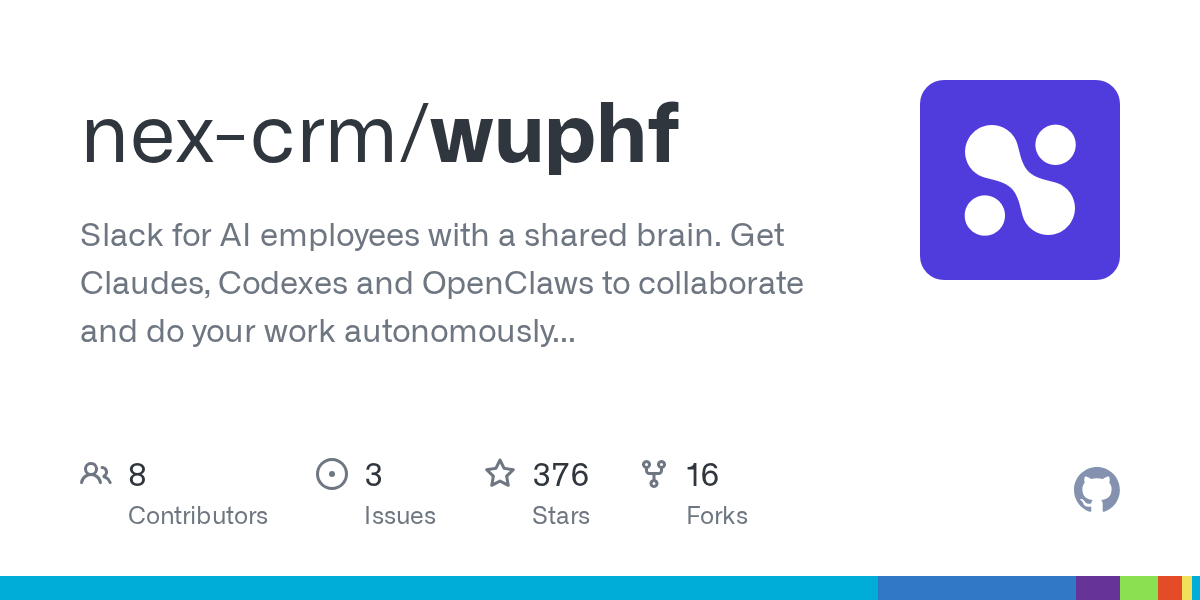
85% Recall, No Vectors: WUPHF Torches pgvector
An MIT-licensed wiki layer for AI agents reframes the agent-memory category around portability and provenance, not vector databases.
A solo developer is shipping an agent-memory substrate built on markdown, git, and BM25, no pgvector and no embeddings vendor. Portability is becoming a buyer demand and the stack is about to feel it.
— WUPHF, collaborative office for AI agents (GitHub) (opens in a new tab)
- WUPHF reframes agent memory around portability and provenance using markdown, git, and BM25, no vector database required, challenging the default stack of pgvector, graph stores, and managed services.
- SMB operators and open-source advocates win; vector database vendors and overbuilt AI infra startups face pressure as 'good enough' local tooling gains traction.
- This mirrors SQLite’s rise in the NoSQL era, where lightweight, embeddable, and portable solutions quietly captured the majority of practical use cases from heavyweight managed systems.
- Watch for adoption in solo-founder and micro-SaaS stacks; operators should test markdown+git+Bleve as a zero-cost, auditable alternative to vector backends for sub-1K document knowledge bases.
The agent-memory category is bifurcating, and a Show HN post this week is the cleanest signal yet of where the second branch is heading. On one side, the managed-vector incumbents: Pinecone, Weaviate, the pgvector-on-Postgres camp, the graph-plus-Kafka reference architectures that every AI infrastructure deck of the last eighteen months has reproduced. On the other side, a small but growing pile of projects that look at that stack and ask whether an SMB operator's notes about thirty-five customers really need a graph database. WUPHF, an MIT-licensed wiki layer shipped as part of an open-source agent office, lands firmly in the second camp. It uses markdown files, git, and BM25 search via Bleve, with SQLite for structured metadata. No vector store. No graph. No dashboard.
The Deployment
WUPHF ships from nex-crm/wuphf on GitHub, installable via npx wuphf@latest. The wiki layer runs locally in ~/.wuphf/wiki/ and is structured as a git repository the user can clone out at any time. Each agent gets a private notebook directory, plus access to a shared team wiki. There's a draft-to-wiki promotion flow, where notebook entries are reviewed and elevated to canonical pages with back-links, governed by a state machine that handles expiry and auto-archive. Per-entity facts are appended to JSONL logs, and a synthesis worker rebuilds entity briefs every N facts, committing under a distinct git identity called "Pam the Archivist" so provenance shows up cleanly in git log. Wikilinks have broken-link detection. A daily lint cron flags contradictions and stale entries.
The retrieval substrate is the headline bet. BM25 via Bleve handles search; SQLite holds structured metadata for facts, entities, edges, redirects, and supersedes. The author reports an internal benchmark of 500 artifacts and 50 queries clearing 85% recall@20 on BM25 alone, which is the published ship gate. sqlite-vec is the pre-committed fallback if any query class drops below that threshold. There's a /lookup slash command and an MCP tool for cited retrieval, with a heuristic classifier routing short lookups to BM25 and narrative queries to a cited-answer loop. Known limits are spelled out in the post: synthesis is only as good as the agent observations feeding it, recall tuning is ongoing, and the scope today is single-office with no cross-office federation.
Why It Matters
The read here is that agent memory is following the same arc as application data did fifteen years ago, and the buyer dynamics are about to look familiar. In the early NoSQL cycle, the default answer to every storage question was a managed cluster, until SQLite quietly ate a third of the use cases by being good enough and impossible to lose. The agent-memory category is at the equivalent moment. The reference architecture every vendor has been pitching, Postgres plus pgvector plus a graph store plus Kafka plus a managed dashboard, is overbuilt for the median operator. Most SMB knowledge bases are not five-million-document corpora. They are three hundred customer notes, a hundred internal procedures, and a thousand call transcripts. BM25 over markdown clears that workload, and WUPHF's 85% recall@20 number on a 500-artifact benchmark is the empirical receipt for a claim that's been floating around developer Twitter for a year.
The competitive set is worth naming explicitly. On the managed-vector side, Pinecone, Weaviate, Qdrant Cloud, and the pgvector-as-a-service crowd. On the agent-framework side, LangChain's memory modules, LlamaIndex's index abstractions, and the memory primitives baked into Mem0, Zep, and the recent crop of MCP servers. WUPHF is not competing head-on with any of them. It is competing with the assumption that a buyer needs any of them, a more interesting and more dangerous competitive posture, because it shifts the buying conversation from "which vector DB" to "do I need one at all". Comparable deals in the developer-tools category trade at sharp multiples when the product dislodges a category assumption rather than a specific competitor; see what Linear did to Jira's reference architecture, or what SQLite has done to the early-stage application database market.
The provenance design is the second-order signal. Commits landing under a named git identity is not a feature. It is a procurement-readiness primitive. Any operator who has been through a SOC 2 audit, a GDPR data-subject request, or an insurance review for an AI deployment knows the question that always lands: who wrote this, when, and from what input. A git blame answer to that question is, on its own, worth more than most of the dashboards the managed-vector crowd is building. The deeper point is that owned, attributable, first-hand data is the asset a competitor cannot copy, the same logic that makes Information Gain the durable lever in content: originality you can prove beats volume anyone can reproduce.
What Other Businesses Can Learn
For an SMB or mid-market operator currently pricing an agent stack, this release is a useful forcing function. Three concrete takeaways.
First, get an honest count of your artifacts before you sign a vector-database contract. The instinct to reach for the heavyweight default before measuring your own numbers is the same trap that has Indian operators optimising for Google when their traffic is on Bing: pull your real figures first, then buy. If you have under five thousand documents and your queries are mostly fact-lookups rather than fuzzy semantic similarity, BM25 is likely sufficient and the managed-vector tier is solving a problem you do not have. Pinecone's serverless tier starts cheap but scales with query volume; a self-hosted BM25 index over a markdown directory has a marginal cost of essentially zero. The gap between those two cost curves at SMB scale is large enough to fund a part-time ops hire.
Second, write portability into your AI procurement template, today, regardless of which vendor you pick. The single sharpest sentence I can offer on this category right now:
If your agent memory does not live in files you can
git cloneout on a Saturday afternoon, you do not own it, and your switching cost is whatever your vendor decides it is in eighteen months.
That sentence applies whether you go open-source or commercial. Ask any vendor in your shortlist for a documented export path that produces human-readable artifacts, not a proprietary binary dump. If they cannot show you one, treat the absence as the price.
Third, separate the substrate question from the agent-framework question. WUPHF's most interesting architectural choice is that the wiki layer is decoupled from the agent runtime; the post explicitly notes that you can point any existing agent setup at it. This is the right shape for a buyer too. You should be able to swap your agent framework, Claude Code today, something else next year, without rebuilding your knowledge base. Vendors that bundle the two layers tightly are protecting their renewal rate, not your operational flexibility.
Fourth, on the provenance question, start the conversation with your auditor or insurer now, before the deployment goes live. Ask them what evidence they will want to see in twelve months. The answer is almost always some version of an immutable, attributable log of what the system said and why. A git history under named identities is one credible answer. An opaque vector store is not.
Looking Ahead
The next twelve to eighteen months will see at least three more credible markdown-or-git-native agent-memory projects ship to general availability, and at least one of the managed-vector incumbents will respond with a portability story of its own, probably under the heading "open data format" or similar. The pressure is one-directional: as audit and procurement teams catch up to AI deployments, portability and provenance move from nice-to-haves to checkbox items. The comparable to watch is Mem0, which has been growing on a similar local-first thesis and will face the same scale-up question WUPHF will face if it gets adoption: when and whether to add a vector layer without breaking the portability promise. The answer to that question, more than any benchmark number, will tell you which of these projects is built for operators and which is built for a Series A.
Sources
- WUPHF, collaborative office for AI agents (GitHub), accessed 2026-04-25
- WUPHF entity-synthesis demo (asciinema), accessed 2026-04-25
More from the same beat.
Heretic 1.3 Ships Reproducible Runs, Bleeds the Fork-Cloners
Same abliteration tool, but now every published model carries a byte-for-byte recipe, and the mystique-merchants lose their cover.
- Reproducible runs are the real release; benchmarking and VRAM are table stakes that should have shipped last year.
Behind Monzo's Madrid Push, the US Retreat Loomed
Same neobank playbook, but Santander's Openbank already owns the Spanish SMB account before Monzo prints its first card.
- Monzo lands Spain with 50 staff and zero products beyond a listening tour. Read it as a foundation move, not a market push.
Moritz Raises $9M, Bleeds Harvey and Legora
The bet isn't selling AI to law firms. It's eating the law firm itself, $2B in contracts at a time.
- Moritz isn't a vendor. It's a law firm that closed $2B in contracts with seven staff and a four-hour turnaround.