
xAI Distills OpenAI: Musk's Trial Confession Torches the Frontier-Lab Moat
Same models, new paint job, Grok runs on OpenAI's outputs, and every operator pricing a sovereign LLM stack just learned what they're really paying for.
He even confessed, to some audible gasps in the courtroom, that his own AI company, xAI, which makes the chatbot Grok, uses OpenAI's models to train its own.
- Distillation is the open secret of the frontier; saying it under oath in Oakland makes it a procurement question, not a rumor.
- OpenAI's $1T IPO math leans on a moat that a competitor just admitted to crossing. The structural bear case got new evidence.
- If you are paying $1.75T-implied valuation for Grok, you are partly paying for OpenAI's training run. Price your stack accordingly.
- Watch any frontier vendor's terms-of-service page in the next ninety days. Distillation clauses get sharper teeth fast.
The frontier-model category has been pricing itself on a moat that operators have quietly suspected was leakier than the pitch deck claimed. This week in an Oakland courtroom, Elon Musk confirmed it under oath: xAI trains Grok on OpenAI's models. That single admission, dropped during the first week of the Musk v. OpenAI trial, is the kind of disclosure that changes how a procurement team reads every frontier-lab pricing page for the next twelve months.
The story most outlets led with is the spectacle. Musk in a black suit, a $38 million grievance, the warning that AI could kill us all, the judge's exasperation. That reading is fine for a news cycle. The buyer-side reading is different. The buyer-side reading is that the argument for paying frontier-lab prices just took a public hit, and the comparable-vendor math the procurement team has been running shifted in the same hour.
The Deployment
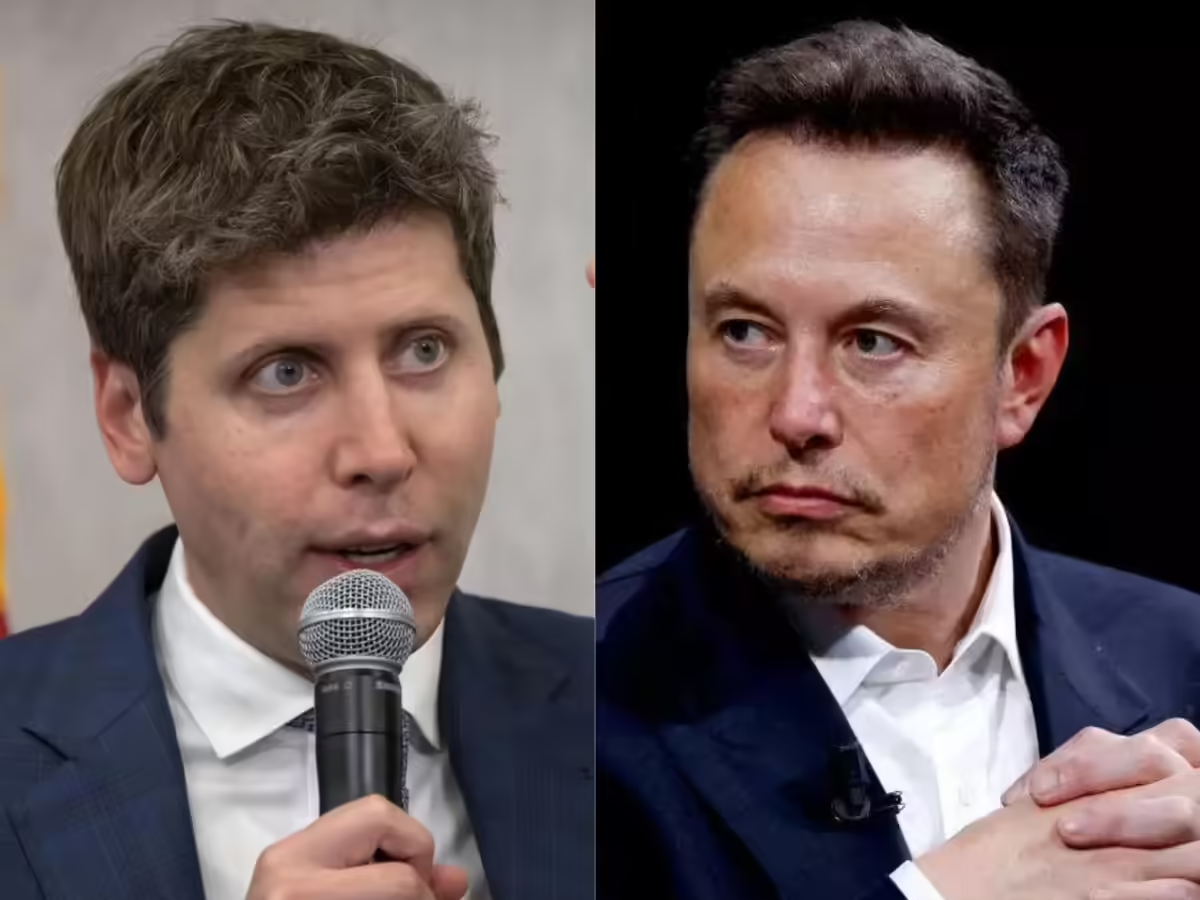
The setting is the federal courthouse in Oakland, California, in the first week of the trial between Elon Musk and OpenAI. Musk took the stand and argued that OpenAI CEO Sam Altman and president Greg Brockman deceived him into bankrolling what was supposed to be a nonprofit. He told the jury he gave them $38 million in what he characterized as essentially free funding, which became, in his telling, an $800 billion company.
The relief Musk is asking for is not damages. He wants the court to remove Altman and Brockman from their roles and to unwind the restructuring that allowed OpenAI to operate a for-profit subsidiary. The MIT Technology Review report frames the stakes plainly: the outcome could upend OpenAI's race toward an IPO at a valuation approaching $1 trillion, while xAI itself is expected to go public as part of SpaceX as early as June, at a target valuation of $1.75 trillion.
The admission that mattered most for the category came during cross-examination. OpenAI's lawyer, William Savitt, who once represented Musk at Tesla, walked Musk into a confession that xAI uses OpenAI's models to train its own. The MIT Technology Review account describes audible gasps in the courtroom. The trial also surfaced that Musk had recruited from OpenAI for both Tesla and Neuralink while still on OpenAI's board, with the now-public 2017 email reading: "The OpenAI guys are gonna want to kill me. But it had to be done."
Why It Matters
The frontier-lab category has been priced on three premises. First, that training a flagship model from scratch is a capital-intensive moat. Second, that the labs at the top of the leaderboard are technically distinct from each other in ways that justify multi-vendor stacks. Third, that the pricing curve will hold because the moat holds. Musk's admission lands directly on premise two and indirectly on the other two.
If xAI is distilling OpenAI's models, the practical meaning is that a competitor at a target valuation of $1.75 trillion is partly riding on OpenAI's training run. not a small footnote. It is the bear case for the multi-vendor procurement story. The reason an operator pays for two frontier vendors is to avoid concentration risk and to arbitrage capability gaps. If one of those vendors is, in any meaningful sense, downstream of the other, the redundancy is thinner than the procurement deck claimed.
This echoes the cloud-services category circa 2014, when buyers discovered that a meaningful share of "independent" SaaS infrastructure was running on the same three hyperscaler backbones. The categories looked diversified on the procurement page and concentrated in the operational reality. Distillation introduces an analogous concentration in the model layer. You can buy from three frontier labs and still be operationally exposed to one training corpus.
There is a second-order read here that matters more than the headline. Distillation as a practice has been an open secret in the field for years; researchers and engineers have discussed it openly in papers and on conference panels. What changed this week is that it was said in court, under oath, by the founder of one of the named competitors. That moves it from a research-community truism to a procurement-relevant disclosure. Legal departments that ignored the rumor mill will not ignore the trial transcript.
The bear case for OpenAI's IPO valuation also gets new evidence. If a competitor can credibly close the capability gap by training on your outputs, the moat you are pricing into your IPO book is the moat that just got crossed in public. Comparable deals in the AI infrastructure category have traded at progressively richer multiples on the assumption of defensible training pipelines. That assumption is now contestable in a way it was not a week ago.
The competitive set worth naming explicitly: OpenAI, Anthropic, Google DeepMind, Meta AI, Mistral, xAI. Of these six, the trial admission directly implicates the OpenAI–xAI relationship. The implication for the other four is contractual rather than technical. Every legal team at every frontier lab is reading the transcript and rewriting the distillation clause in their terms of service. Buyers should expect those clauses to be enforced, not just published.
What Other Businesses Can Learn
For the operator pricing a frontier-model stack right now, the trial has changed three things in the cost model and one thing in the contract.
First, treat "trained from scratch" claims as marketing until they are written into your contract as a representation. The procurement question to add to every frontier-vendor RFP this quarter is straightforward: does the vendor represent and warrant that no training data, model weights, or model outputs from a competing frontier lab were used in the development of the model you are licensing? If the answer comes back hedged, that hedge is now priceable.
Second, audit your multi-vendor redundancy assumption. If you carry two frontier vendors specifically to mitigate single-vendor concentration risk, ask whether the vendors are technically distinct or merely commercially distinct. The Oakland admission suggests these are not the same thing. A 50-person operations team running production agents on a primary-plus-fallback design should be running a real failover drill, not a contractual one.
Third, adjust your view on pricing power. The read: that frontier-lab pricing power is partially a function of moat narrative, and the moat narrative just absorbed public damage. Vendors will not cut prices in response to a single trial week. But the next renewal cycle, particularly for enterprise contracts north of seven figures annually, is the right moment to test how much the narrative damage has translated into negotiating room.
The redundancy you thought you bought by going multi-vendor is thinner than the procurement deck suggests.
Fourth, on the contract side: any clause in your existing frontier-vendor agreement that allows the vendor to update training methodology without notice is worth flagging now. The next twelve months will produce vendor-side amendments to terms of service that tighten distillation prohibitions. You want to be in the room for those amendments rather than receiving them as a fait accompli.
Looking Ahead
Over the next twelve to eighteen months, expect three category moves. Frontier labs will tighten distillation language in their terms of service and start enforcing it through API monitoring rather than honor-system prohibition. Procurement teams at mid-market and enterprise buyers will add distillation representations to standard RFP templates, the way they added data-residency clauses after 2018. And the IPO window for any frontier lab pitching a moat narrative gets harder to clear, particularly for any vendor whose comparable-deal book leans on the OpenAI valuation curve. The named comparable to watch is Anthropic's next funding round; if the moat-narrative damage is real, it will show up there before it shows up in OpenAI's S-1.
Related
- Frontier Model Forum and the China model-copying question
- Commerce locks Google, Microsoft, xAI into pre-release federal audits
- OpenAI crowds out premium ChatGPT, bets ads beat seats
Sources
Topics
More from the same beat.
Information Gain Is the 2026 Ranking Lever. Generic AI Content Is Suppressed.
The winning move is not more pages or more keywords. It is one genuinely new, first-hand thing per page. Everything else gets quietly shelved.
- Information Gain is the central 2026 signal. Google's patent, granted in 2024, scores a page on what it adds that the rest of the results for that query do not already have. A reword of the top ten…
vLLM at 10K QPS: What 50-Engineer ML Teams Learned Scaling Open-Weight LLM Inference
It runs on your H100 cluster, but the audit trail lives in your runbook.
- Your GPU spend drops 5-10x not from raw speed but from PagedAttention’s memory efficiency, teams that skip tuning KV-cache size bleed throughput silently.
40 Models Don't Win the Procurement Call. Five Do.
AWS Bedrock now lists dozens of foundation models, but the enterprise teams already running production workloads have converged on a shortlist of five, and the rest is evaluation overhead.
- A catalog of hundreds doesn't serve buyers; it taxes them. Evaluation cycles eat quarters that most enterprise teams cannot recover.